Marque landing · 1 cars on the board
Ford rental
Kuala Lumpur
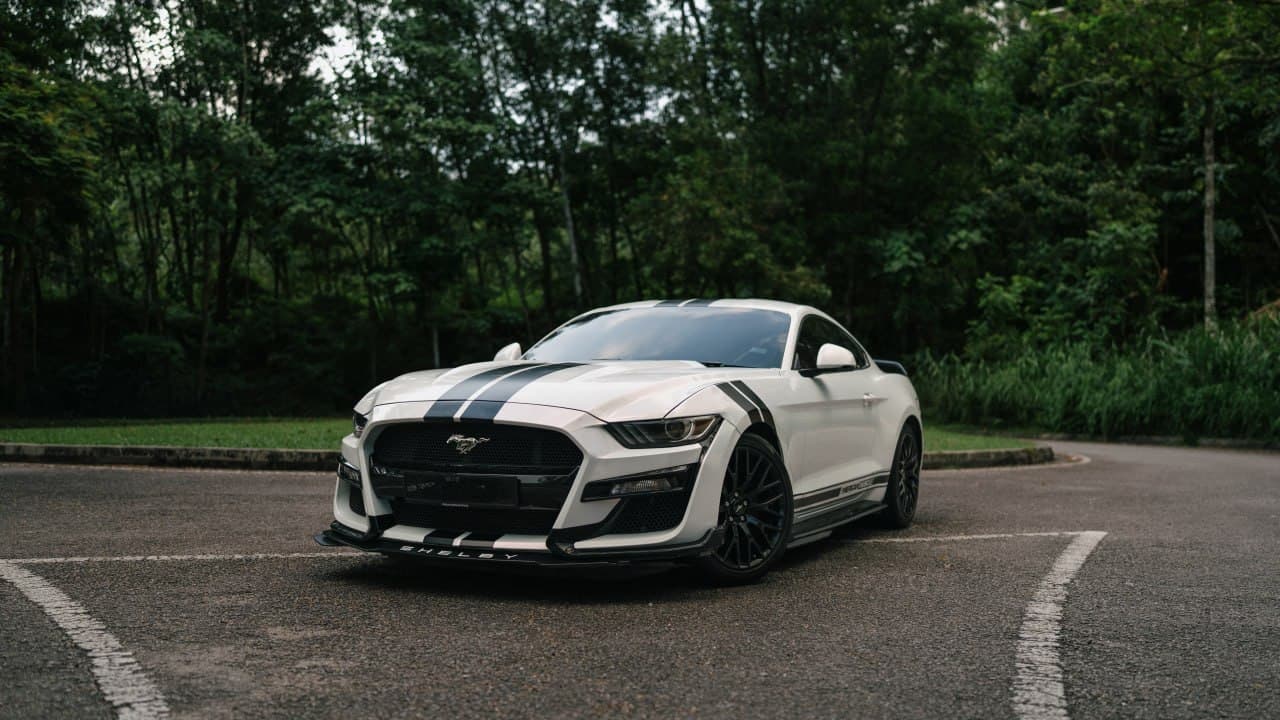
Detroit's simplest idea: a long bonnet, rear-wheel drive and a low price of entry.
Cars held
1
Peak output
314bhp
Quickest
5.5s
Highest v-max
250km/h
From
1,149RM/day
The engineering
Why Ford drives the way it does
The Mustang has been in continuous production since 1964 and its formula has barely changed: put the engine at the front, drive the rear wheels, make the bonnet long and the boot short, and price it so that ordinary people can buy one. That last part is the whole point and the reason it matters. The Mustang democratised the fast coupé in America the way the Mini democratised the small car in Britain, and it is still, adjusted for what it does, remarkable value.
The 2.3 EcoBoost version is the one that draws the most argument from purists, and their objection — that a Mustang should have eight cylinders — is emotionally reasonable and technically outdated. The EcoBoost four is a twin-scroll turbocharged unit derived from Ford's Focus RS engine programme, and it makes its torque low and flat in a way the old atmospheric V8s never did. It is also around 90 kilograms lighter over the front axle, which changes the balance of the car noticeably for the better. It turns in more willingly and it does not understeer into a corner the way a V8 car will.
For Malaysian conditions the four-cylinder makes even more sense than it does in America. The roads here rarely give you the space to use a big atmospheric engine properly; what you actually need is 40 to 100 km/h punch for an overtake on a two-lane road, and turbocharged mid-range delivers that better than displacement does. Fuel consumption is also survivable, which on a 300-kilometre Karak-and-Bentong day is not a trivial consideration.
What you get with a Mustang that you do not get elsewhere in this price bracket is presence. It is long, wide, loud enough, and instantly recognisable to absolutely everyone — including people with no interest in cars at all. For a birthday, a photoshoot or a first taste of a rear-drive coupé, that recognition factor is worth as much as the specification sheet.
Every Ford we hold
Compare against the whole fleet →The cars
| # | Car | Power bhp | RM / bhp † |
|---|---|---|---|
| 01 | Ford Mustang 2.3 EcoBoost2.3L Turbo I4 · RWD · TURBO · 10-speed auto5.5s · 250 km/h · RM 1,149/day | 314 | 3.7best |
† RM / bhp is the daily self-drive rate divided by the manufacturer’s brake horsepower, to one decimal. It is a blunt instrument — it ignores tyre width, kerb weight and where the torque actually lives — and it is still the fastest way to see what a badge is charging you. Power bars are scaled against 314 bhp.
Questions
View all →Ford hire — asked and answered
Is the EcoBoost Mustang a real Mustang without a V8?+
It is a real rear-drive Mustang with a lighter nose and better mid-range torque than the old atmospheric V8s. You lose the eight-cylinder soundtrack. You gain a car that turns into corners more willingly and costs far less per day.
Is a Mustang easy to drive for a first rear-drive car?+
Reasonably, in the dry, with traction control on. In the wet, treat the throttle with respect out of junctions — a long-bonneted rear-drive coupé on a greasy Malaysian road will step out if you provoke it.
Cross-reference
Comparing Ford against something else? These are the other marques on the board, each with its own engineering write-up.